Every year for the past six or seven years I have gone to Tokyo Food-X, a big food trade show held at Tokyo Big Site, in Ariake. It is mainly an event for foreign food and beverage companies to try to get their product into the Japanese market, although there are also Japanese producers who want to show off their wares. I have been introduced to quite a few “interesting” things (sake made from mare’s milk) and have met some cool people.
Here is a recap of what I saw and tasted at the 2026 version of Food-X.
The first day, Tuesday, March 9, was cold and rainy, with some snow mixed in during the morning, so I waited to go until afternoon when it was a bit warmer, and not raining. I usually ride my bicycle to Big Site, but not today as it is still cold. So I split the trip, biking to Shintomichō, then took the subway to Toyosu where I caught the Yurikamome line to Big Site. A much more time consuming way to get there than by bike.
The south side of the far east wing of the hall was closed. In the past that spacious room had been where much of the non-Asian exhibitors were, as well as much of the Chinese. Although I did not see everything on the first day, I didn’t see any Chinese at all. Lots of Exhibits from Taiwan, Thailand, and Korea. But no sign of China. I have a suspicion it is because of the currently poor state of relations between the Japanese and Chinese governments.
First day impressions:
Korea has a huge presence, probably the biggest aside from that of Japan which I did not have time to see. Noticeably missing was the usually fairly large contingent from China. The only presence I spotted was a company from Shanghai that deals in pink (rose) salt mined in Pakistan, Himalayan pink salt. It is something I always have in my kitchen and use regularly for cooking.
Lots of rum, not so much whiskey. There was one particularly delicious rum from Australia that had been aged in pinot noir casks, giving it a reddish color and a very fruity flavor. I normally don’t drink rum, but that may be changing soon.
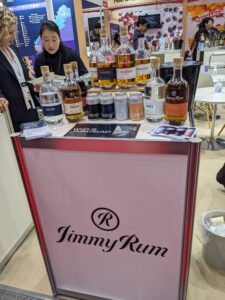
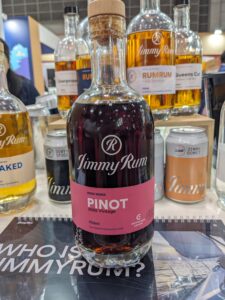
Several olive oils from Australia were on display, including one brand I had bought in Australia last year that I wish was available in Japan.
Positioned off to the side of the Australian exhibit was a guy who makes mead. But not just any mead, but mead more like fine wines. He even had sparkling meads. Mead is fairly easy to make; just add water to honey and add some yeast, or even wild yeast, and let it ferment. It has been around for perhaps 20,000 years or more and is considered to be the first alcoholic beverage ever consumed by humans. But this was something special.
The brand is Aurum, Au being the chemical symbol for gold, the color of the honey that is used, while rum refers to the beverage, something Australia is famous for (it was the first money used when the British arrived). I was surprised when I first tasted the mead as it was not sweet, like all the meads I had tasted before. I struck up a conversation with the maker, Louis, who was originally from France but now lives and makes his mead in Australia. We exchanged cards and he invited me to a tasting event he had going on the next week. This was definitely one of the most interesting things at Food-X this year.
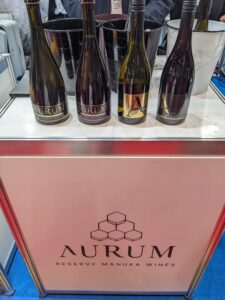
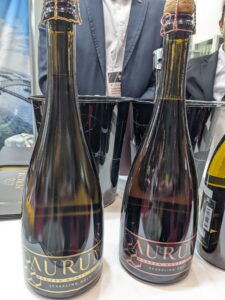
Several macadamia nut companies were passing out samples. One, from the Big Island of Hawaii, was offering small cups with several whole nuts; one from Australia had nuts with the shell still on with someone nearby to pry them open (I experienced this in a couple of brew pubs in Sydney last year); and one had nuts with different flavorings added.
Canada had a fairly large contingent, mostly with maple syrup vendors. But there was also someone from Quebec who was pushing his horseradish. There were three strengths, mild, medium and hot. He offered me the mild first; no heat at all. Next was the medium, and it had a little bit of lunch to it, maybe just the right amount of heat. When it came to number three I thought “no problem,” and put it in my mouth. It was hot, hot enough to make my face sweat. After that I returned to one of the Australia tables for a sip of Hunter Valley wine to cool off.
As I was walking along the back aisle of the East Hall a bottle of very black sesame oil (goma abura) from Taiwan caught my eye. I stopped and took a few steps back to get a better look. When offered a taste I was eager to try it, it was that unusual looking. It had a very strong flavor, and the oil seemed thicker than any other sesame oil I had come across. It didn’t seem suitable for frying, unless just a few drops were added to other, lighter oil. Very interesting.
After walking another minute or two I found myself back in the Canada section, with a very strong taste of oil still lingering in my mouth. Fortunately I came across just the thing I needed to cleanse my palette: Horseradish from Quebec.
There were three strengths; mild, medium and hot. The mild was indeed mild, as was the medium. When I tried the spiciest mix I felt my face start to sweat. But at least the oil was gone. Luckily there was a table with wine samples just steps away. After a couple of sips of Australian wines I was back to normal. And it was 5:00, meaning the day was over.
DAY 2
I returned on Friday, the final day, this time by bicycle. I like going o the last day as inevitably I end up with some leftover product that people don’t want to haul back to their home country.
I started the day in the West Hall, which was where most of the European exhibiters were. The first thing that caught my eye was a display of vanilla. Vanilla beans, vanilla extract, and I think a powdered vanilla. What was weird, though, was that this was part of Lithuania’s exhibition. And vanilla is a tropical or sub-tropical plant. Actually, a type of orchid. I remembered seeing another vanilla exhibit on day one, in the East Hall. But I didn’t pay much attention to it. On this day I decided to stop and check it out.
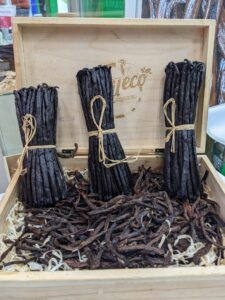
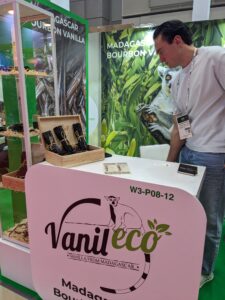
It turns out the company, Vanil-eco (https://www.vanileco.com/), is based in Vilnius, Lithuania. But their production is in Madagascar. I chatted with the rep for a while and learned that this was the same company as in the East Hall. I told him about an idea of mine to turn vanilla into an alternative to gourmet chocolate. Maybe figure out a way to do taste comparisons between vanilla from different parts of the world. Then he said he wanted to send me home with some beans, but he needed to go back to the other booth to get them. So I told him I would return later. Which I did to receive a big bag of beans. Not sure what to use them for, but it was a great gift none the less.
One thing I was a bit surprised to see was chocolate makers from northern European countries, including Estonia, Denmark, and a couple others.
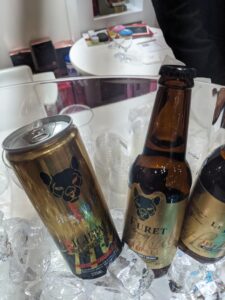
By now I was in the France area, which of course meant lots of wine to sample. Two of the more notable products were cognac from a company called Le Furet (the puma, or mountain lion) and a Basque whisky, from Spain but brought by the cognac company. The cognac was very good, although the initial sip came as a shock to my mouth. They also had cans and bottles of cognac highballs, which at only 6% alcohol was quite refreshing. This was the first time I had ever tried any Basque whisky, and it was quite good. And as I recall, aged in bourbon barrels, meaning from America.
There were several products from Finland, but only one I paid attention to: Craft beer from Kukko Brewing, Kukko meaning rooster, which is what appears on their labels.
I sampled their IPA (very good, but with a different mix of hops than usually used in IPAs), and another beer I was unfamiliar with, “thuma”. I returned at the end of the day to ask about something to take home and received a can of the IPA to share with some Japanese brewer friends who liked it. I did a bit of research later and learned that the brewery is 100% powered by wind.
There was also a French wine and champagne booth staffed by a very generous Japanese gentleman. Very generous, as in nice big pours of fairly expensive champagne (one bottle retails for ¥60,000, he said). Further on, in the Japan area, there were several nihonshu makers offering pours, as well as a big display of Matsui Whisky (from Tottori, prefecture), my favorite everyday whisky for making a highball.
Among the French exhibitors was an olive oil producer whose product I recognized as I had just finished a small can of their oil. What I had before was plain extra virgin oil; for this event they also had an assortment of flavored oils, the most interesting being a one with macha tea they had created just for this event. It was very green in color, just like a bowl of macha. It was also pretty good when I sampled some on a piece of bread. There were also more traditional flavorings, including rosemary and basil, which I was given a small bottle of.
The most popular exhibit was a Korean company promoting their cheese ramen, and doing it by handing out bright pink shopping bags. Every time I looked there was a long line of mostly young people waiting to get a taste of their ramen and a bag to take home.
Just before closing I returned to a French wine company where I had spent some time earlier and left with three bottles of wine to haul down the hill and back to my home. Good thing I had brought a small backpack.